Tuesday, July 2, 2013

Creating a Statue for Bessie Coleman


  • Poli-Tainment, Inc. is looking at different ideas on having a Bessie Coleman memorial statue placed at the Jacksonville International Airport in Florida. This is the city where Queen Bess, an aviatrix pioneer, fell 2,000 feet from her airplane - one day before an airshow she was to headline.

  • We will begin a fundraising campaign to pay for the statue after we find the best artist and know the price. 

  • A life-size bronze art piece seems to be a top contender. We encourage anyone who has interest to present ideas. This project is not specific to the memorial city. All admirers in all countries are encouraged to submit ideas. 

  • All donor names will be a part of the memorial.

  • We will continue to pursue ideas to honor Brave Bessie.

Monday, June 24, 2013

Historical Resolution Honoring Bessie Coleman Set for August 27, 2013


Great News!


The resolution to honor Bessie Coleman has been approved by the Jacksonville, Florida city council and signed by the mayor. Please keep August 27th (Tuesday) 5:30 pm open on your calendar if you plan to attend this historical occasion at the council meeting - 


located:  Jacksonville City Hall 117 West Duval St., Suite 425. Jacksonville, FL 32202 

adjacent to Hemming Plaza downtown. 

Also, send me a message if you would like a reserve seat to politainment1@gmail.com. 


Thanks so much for your contribution and support for this incredible pioneer in aviation.

Wednesday, May 8, 2013

Draft City Council Resolution Honoring Bessie Coleman

This is the draft resolution honoring aviatrix pioneer Bessie Coleman.  It will be presented at the next big city council meeting. The public is welcome and encouraged to come and witness history in the making.


THIS IS A DRAFT

Introduced by Council Member Jones:       

RESOLUTION 2013-
A RESOLUTION HONORING AND COMMEMORATING THE ACCOMPLISHMENTS OF PIONEERING AVIATRIX BESSIE COLEMAN; PROVIDING AN EFFECTIVE DATE.

     WHEREAS, Bessie Coleman was born January 26, 1892 in Atlanta, Texas and raised in Waxahachie, Texas where she was the tenth of 13 children and attended a one-room segregated schoolhouse and became the family’s bookkeeper at a very young age for her mother’s cooking and housekeeping business; and

     WHEREAS, Bessie Coleman at 18 years old attended college at the Colored Agricultural and Normal University in Langston, Oklahoma for several months before she ran out of money and headed back home to Waxahachie in grand style with members of the marching band in tow; and she moved to Chicago several years later during the mass migration from the south during World War I where she worked and became known as the fastest manicurist in the city while dreaming of learning to fly and becoming a pilot in the new world of aeronautics; and

     WHEREAS, in 1920 Bessie Coleman, having learned French and using money that she had saved, and receiving an investment from an African-American banker, went to France where gender and racial prejudice was much less pronounced, and completed an aviation course, becoming the first American to receive a pilot’s license from the Federation Aeronautique Internationale and thereby became the first licensed black pilot in the United States upon her return to America; and

     WHEREAS, Bessie Coleman performed in air shows around the country where she became known as “Queen Bess” and “Brave Bessie” as a result of her breath-taking air maneuvers and highly entertaining parachute jumps, and the Norman Studios in Jacksonville communicated with Bessie about using her flying skills to make what will later become The Flying Ace, and Queen Bess gave lectures inspiring others to pursue their dreams all while saving up money to make her dream of opening a flight school come true so that African Americans could learn how to fly here in the United States; and

     WHEREAS, in 1926 on April 30th while on a barnstorming tour in Florida, Brave Bessie fell from her plane in Jacksonville at the now defunct Paxon Airfield where Bessie Coleman was killed, and thousands of mourners filed pass her coffin here at the St. Philips Episcopal Church and Bethel Baptist Institutional Church; now therefore

     BE IT RESOLVED by the Council of the City of Jacksonville:
     Section 1.      The City of Jacksonville hereby honors and commemorates a legacy of pioneering aviation, self-confidence and heroism of famed African-American female aviatrix Bessie Coleman, and urges all people to profit from her example of persistence and self-determination to follow her dreams and achieve unprecedented success despite long odds and discouraging circumstances.
     Section 2.      Effective Date.  This Resolution shall become effective upon signature by the Mayor or upon becoming effective without the Mayor's signature.

  ======================================================


Tuesday, May 7, 2013

Bessie Coleman Scout Trip to Jax Intl Airport

Scouted out Jax Intl. Airport to gain info for the Bessie Coleman honor we are pushing to be displayed there. Looks like plenty opportunities exist for something befitting Brave Bessie's memory. Pioneer aviatrix Bessie Coleman died in Jax FL in 1926.


I am curious as to who or what this female art statue is.
I will be getting back to you on this.  Was told that it was some
sort of Greek Mythical entity.


This is a display case you will see after getting off the airplane and  walking to get your
luggage.  
On the other side (through the glass) is where passengers walk to go to the gates.


This is a sitting area just before a passenger goes to the security check.
This area 
is lined with shops, a piano and a shoe shine stand.


These escalators lead to the baggage claim.


This display case is in the area below in the baggage claim
area. These are some really nice photos. 
I think the caption was "Jacksonville Takes Flight."


Monday, May 6, 2013

Bessie Coleman Statute at Jax International Airport

Headed to the Jax International Airport to talk to them about a statute or bust of Bessie Coleman to be placed there. Another airport here (Craig's Executive Airport) is where I rented a hangar to do the Bessie Coleman research several years ago. That airport has a street named after Amelia Earhart (who idolized Queen Bess).  www.poli-tainment.com

______________________________________________________________


Monday, April 29, 2013

Florida Times Union Corrects the Record on Aviatrix Bessie Coleman


In 2013, one day before the 87th anniversary of the death of Bessie Coleman here in Jacksonville, Jacksonville.com (The Florida Times Union) posts an historical article about Bessie Coleman. This publication slighted her in 1926 arguably because she was a black woman.


___________
________________
_________
_________________________________________________________

Congrats to Bessie Coleman on a front page honor in Jacksonville's Florida Times Union newspaper. A paper that slighted her in 1926 when she died (April 30), finally corrected the record - on the 87th anniversary of her death in that city. www.Poli-Tainment.com


The Florida Times Union Features Aviatrix Bessie Coleman on Front Page

The Florida Times Union runs Bessie Coleman story on front page April 30, 2013.
___________________________________________________
____
______________________________

Jacksonville asked to honor first black woman pilot


Opio Sokoni sits under the plaque commemorating the first black woman pilot in the U.S. who died in a plane crash at Paxon Air Field which was located near where Paxon High School is now located.  Bessie Coleman crashed and was killed in a flying accident on April 30, 1926.  Bob Self/The Florida Times-Union
Bob Self/The Florida Times-Union
Opio Sokoni sits under the plaque commemorating the first black woman pilot in the U.S. who died in a plane crash at Paxon Air Field which was located near where Paxon High School is now located. Bessie Coleman crashed and was killed in a flying accident on April 30, 1926.


It was big news in Jacksonville, briefly, 87 years ago.

On April 30, 1926, the lead headline of the afternoon edition of the Jacksonville Journal was played big: “Jax Airplane Crash Kills Two.” The headline in the next morning’s Times-Union was smaller but flashier: “Death at controls of airplane as two are flung from the sky.”

The stories recounted how aviatrix Bessie Coleman — the first black woman to get a pilot’s license — fell 2,000 feet to her death from an out-of-control plane piloted by William Wills, who was killed as the plane exploded on impact.

Thousands of people attended a memorial service in Jacksonville for Coleman, a celebrity pilot known for her daring, her perseverance and her beauty. Then the city moved on. Now there’s scant evidence in the city where she plunged to her death that she was ever there.

Jacksonville native Opio Sokoni is pushing to change that. He thinks there should be something named for her in Jacksonville — afterall, a main road at O’Hare International Airport in Chicago is named Bessie Coleman Drive.

“Here, I found out, no streets, no schools, no libraries, no parks. No nothing,” Sokoni said.
He found some support when he asked the City Council last week to do something to memorialize Coleman.

Councilman Warren Jones, whose district takes in the area where she died, said he’ll introduce a resolution honoring her. In an interview after the council meeting, he said he will also look into renaming a street or a park after Coleman, though that isn’t always an easy thing.

“He brought up a good point,” Jones said of Sokoni. “I’m just trying to determine how best to do it.”
Councilman Bill Gulliford said he’d support doing something more than a resolution.

“I think that for a woman, and especially as an African-American woman, in that time, to accomplish what she did was pretty doggone impressive,” he said.

There is one reminder of Coleman in Jacksonville already.

In January 2012, a bronze plaque of “Queen Bess,” as she was known, was placed next to the front doors of Paxon School for Advanced Studies, which in the 1920s was the site of the airfield where Coleman’s fatal flight began. It was unveiled by members of the Bessie Coleman Aerospace Legacy Inc., founded by a group of African-American female pilots.

That group sponsors an essay contest for Paxon students, and students see the plaque every day, said the school’s principal, Royce Turner. “She is kept alive in that way,” he said.

The school has another aeronautical connection: The road in front of it has already been renamed for Paxon grad Norman E. Thagard, a one-time astronaut. “And we’re the Eagles, and that gives us another connection to flying,” Turner said.

Marisa Carbone of Atlantic Beach researched Coleman’s life for a screenplay that was featured at a script contest at the Jacksonville Film Festival in 2004.

“You know, there should be a statue here, there really should,” Carbone said. “She was a pioneer here. She was before Amelia Earhart.”

Coleman, the daughter of Texas sharecroppers, was intrepid: When schools in America wouldn’t teach her to fly, she went to language school to learn French, then traveled to France to get her pilot’s license in 1921.

She was pretty and engaging and brave, which made her a favorite of the Chicago Defender newspaper, a black publication that frequently put her on the front page. Railroad porters put copies of the paper on trains, which then took it around the country, where word of the barnstorming pilot spread, Carbone said.

Coleman put on flying displays around the country, and came to Jacksonville in 1926 to prepare for a big show on May 1. The day before, she and Willis took off to scout out where she would make a parachute jump the next day.

In flight over the Westside, the plane, a Curtiss JN-4, went into a sudden dive and Coleman, who was peering over the side, fell to the ground. Wills died moments later in the crash landing. News reports at the time said a wrench had slid and jammed into the “control gears” of the plane.
“They had a huge service for her at Bethel [Baptist Institutional Church],” Carbone said, “and then they put her body on a train, and all across the country the train stopped and there were services along the way, and when it got to Chicago there was an even bigger service.”

Books have been written about Coleman, and she was honored with a postal service stamp. Mae Jemison, the first black women to fly in space, called Coleman an inspiration. On the anniversary of her death, pilots in Chicago do a flyover past her grave.

A resolution in Jacksonville would be nice, Sokoni said, but it’s not enough.

He’s 43, a Navy vet and graduate of Howard University law school. His family goes back generations in Cosmo, a little community in Fort Caroline. After law school he went west and ran a small radio station in Portland, Ore., and had a few stints on TV facing off against Fox News hosts such as Michelle Malkin, Bill O’Reilly and Laura Ingraham. Back in Jacksonville, he now heads a nonprofit called Poli-tainment Inc., which mixes entertainment and social issues.

That’s where he learned of Coleman’s story, which he made into a short film, “Bessie Coleman: Flying the Blues,” that’s now on YouTube. “Bessie Coleman was one of a kind,” he said. “People need to know about her.”

And the city where she died, he figures, needs to do something more to keep her story alive.
“I don’t want this to be just a black thing,” Sokoni said. “The entire city needs to understand that this woman belongs to all of us.”

Matt Soergel: (904) 359-4082
________________________________________________
Opio Sokoni sits under the plaque commemorating the first black woman pilot in the U.S. who died in a plane crash at Paxon Air Field which was located near where Paxon High School is now located.  Bessie Coleman crashed and was killed in a flying accident on April 30, 1926.  Bob Self/The Florida Times-Union
Bessie Coleman Plaque at Paxon High School
Bessie Coleman
Bessie Coleman

___________________________________________________

Jacksonville, Florida City Council members Gulliford and Jones were the first to speak up in support of honoring aviatrix pioneer Bessie Coleman in a major way in the city.

Councilman Gulliford
Councilman Jones
_____________________________________________

Bessie Coleman Fying the Blues
FILM:


_______
______________
______


Sunday, April 28, 2013

Opio Sokoni's St. Philips Episcopal Church Speech about Aviatrix Bessie Coleman


SPEECH TEXT
April 28, 2013


He knows my soul so weak and blind, 
So full of fears of mortal mind,
And He will lead, and I shall find
The way to Him, I know.
He guides my steps, and He knows best,
He will not harm where He is blessed.
And so goodnight, I'll take my rest,
Where sweet wild roses grow.

Thank You:   Father Hugh Chapman, Rector
                      The St. Philips Church Family
                      And a special thanks to your administrator
                      Mrs. Barbara Lee who gave me a church
                      tour during the week.

             The words I opened with are lyrics to “I’ve Done My Work” - the favorite song of Pioneering Aviatrix Bessie Coleman who died here in Jacksonville in 1926. She had two funerals here in the city. One was at Bethel Baptist Church and the other funeral was here. That song would have been sung here that day.

A movement is now under way to properly honor her memory here in Jacksonville.

I would like to read to you the letter I read before the City Council last week at their meeting.


          I would like to personally thank St. Philips Episcopal Church for being among the first to honor Bessie Coleman. And, for still being here in the same place for so many years.

          Bessie’s story has some parallels to the disciple Philip in the Bible. I’m the grandson of two pastors and I seem to remember that Apostle Philip was with Jesus when he fed the multitudes with the five loaves of bread and fish. That feast is held around May 1. Bessie came her to headline the airshow here on the very month and day in 1926. Bessie’s funeral was held here almost to the exact day.

Bessie died doing what she loved in the field of aeronautics. Her dream was to open up a school so that Blacks did not have to go to France to learn how to fly. When she died, people were so inspired that flight schools were opened in her honor. One such school created the Tuskegee Airmen who were heroes of WWII.  I think about the Apostle Philip being hung upside down and preaching from the cross. Bartholamew was released as a result of St. Philips preaching. He, himself, refused to be taken off the cross and died for his convictions. Your church and you are special. You are here for a reason.

          I want to end by citing the words of another song that the research said was sung at her funerals. The song is entitle, “Jesus Savior Pilot Me.” The last verse of the song goes…

When at last I near the shore,
And the fearful breakers roar
’Twixt me and the peaceful rest,
Then, while leaning on Thy breast,
May I hear Thee say to me,
“Fear not, I will pilot thee.”

Thank you so much for having me. This is such an honor.
_________________________________________________________
__________________________________
___________________
___________
__

_______________________________________________
_________________________
_________


This is how St. Philips Episcopal Church would
have looked during Bessie Coleman's Funeral

Order of Leadership at
St. Philips Episcopal Church
Note: Reverend Parchment is
the Rector in 1926, the year
Bessie Coleman's funeral
was held at the church.

Reverend Satterwhite
would have been at
Bessie Coleman's Funeral.
He was the Rector before and
after Reverend Parchment who
was the Rector when the funeral
was held for Bessie Coleman at
St. Philips Episcopal Church.

Current Picture of St. Philips Episcopal Church


Father Hugh Chapman is the current Rector of
St. Philips Episcopal Church

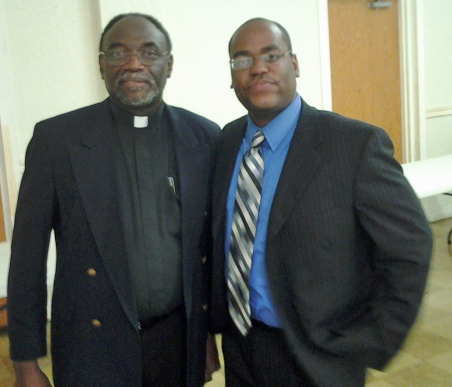
Reverend Hugh Chapman and Opio Sokoni

Opio Sokoni is an activist, researcher of
Pioneering Aviatrix Bessie Coleman
in Jacksonville, Florida
_________________________________________________
Program - April 28, 2013


____________________________________________________________